Your Flavor, Your Ferment: An Introduction to Kombucha Brewing Science and Creativity
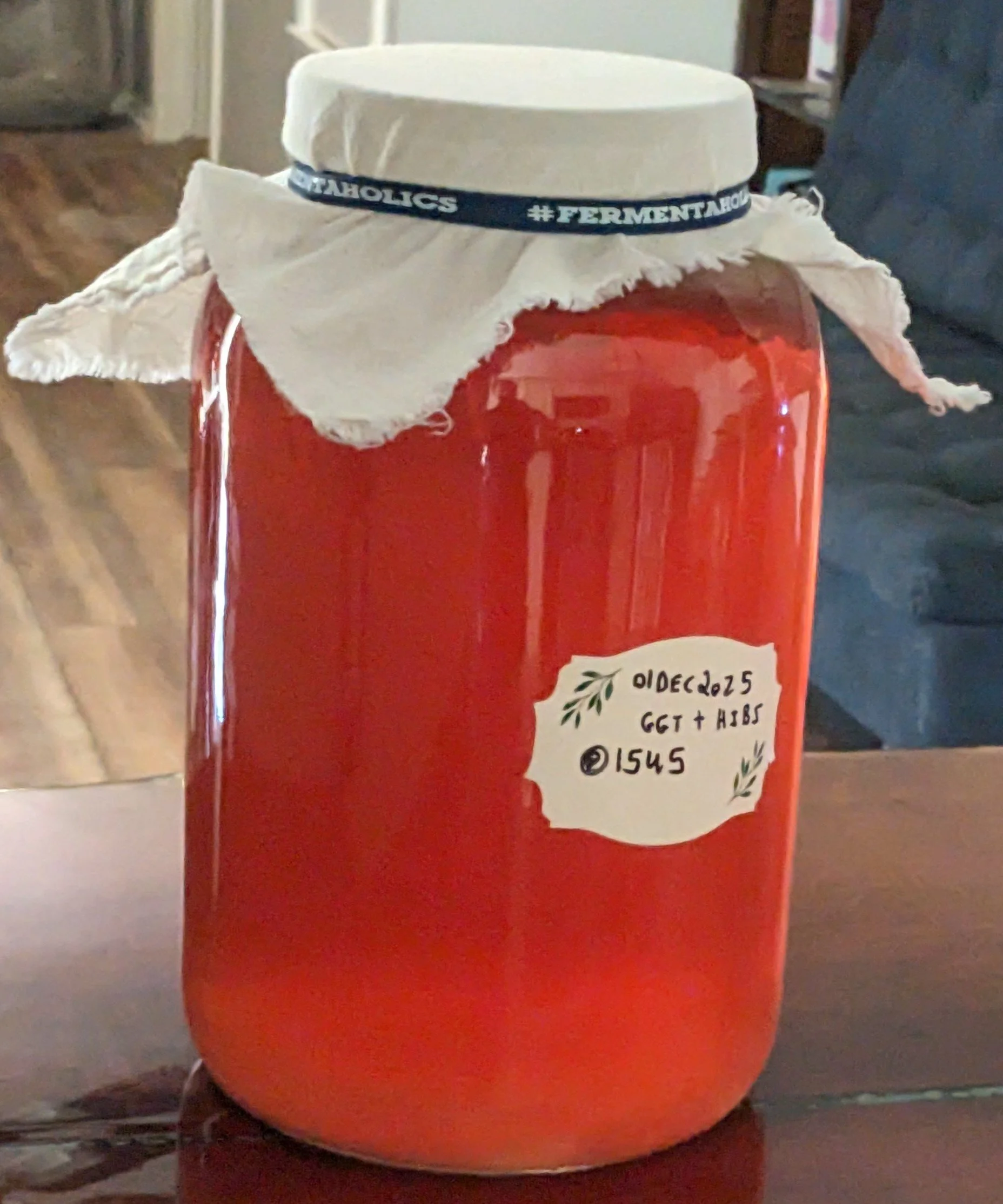
Gunpowder Green Tea and Hibiscus
A good mix of sweet and sour. This brew had a light sour flavor. Only seven days of fermentation. Temperatures were cooler, so fermentation rate wa slower. Average temperature of my house was around 70 F (21 C). Overall a great brew with a more mellow overall flavor profile. I tend to go with the flow of the seasons as far as temperature. Generally closer to 78-80 F (25.6 - 26.7 C) in the summer and around 70 (21 C) late fall to early spring.
Kombucha has gained popularity for its low sugar content and potential health benefits. Unfortunately, with increasing demand, it's often unaffordable for many to consume regularly. Compounding this, some commercial companies may pasteurize their product to eliminate pathogens, but this unfortunately also eliminates many of the beneficial bacteria and yeast, negating the whole purpose of drinking a fermented beverage. If you're looking for more than just carbonation, making your own kombucha allows you to control the quality, save money, and craft unique flavor profiles.
Kombucha is an art as much as it is a science. To unlock the creativity of flavor, we must first master the fundamental science required for a safe and healthy fermentation. The SCOBY, a Symbiotic Culture of Bacteria and Yeast, relies on specific conditions to thrive and produce the protective metabolites that limit pathogens. This brings us to the core rules of brewing.
The Science of Kombucha: Rules for a Safe Brew
pH
The pH needs to be 4.5 or lower as most pathogens are eliminated. It's best to add 12-20 ounces of starter tea to ensure pH is at or below 4.5. 4 - 4.5 is a good pH range. I recommend buying a food grade pH meter to ensure you are within the proper range.
Temperature
You must keep the kombucha between 65 - 85 F (18.3 - 29.4 C) to maintain active fermentation. Ideal range is 75 - 80 F ( 23.8 - 26.6 C ). The yeast and bacteria that are used to make kombucha function best in these ranges. Temperatures above 85 F (29.4 C) are breeding grounds for many pathogens. Most likely the environment will be very humid and even if the room is disinfected regularly there is an increased chance of pathogens contaminating your brew. Too cold of temperatures could create a situation where the yeast and bacteria go into hibernation. While this is ok if you're not actively brewing, if the environment is humid mold could grow and cause contamination within your brew. During active fermentation the SCOBY produces protective metabolites that help limit pathogens and this is why temperature is very important in brewing kombucha.
Sugar
Granulated white sugar is preferable for a more neutral flavor, although brown sugar has molasses and can create a more complex flavor profile. If you're worried about high sugar content, the sugar is to feed to yeast and bacteria, and very little will remain even after a seven day fermentation.
To simplify understanding of the fermentation process, the following is the role of the yeast and bacteria:
Yeast breaks down glucose into alcohol.
Acetobacter metabolizes the alcohol, producing acetic acid (sour taste).
Gluconobacter bacteria break down glucose into gluconic acid (sweeter, balanced taste).
Komagataeibacter xylinus along with other Komagataeibacter species and Gluconobacter species produce cellulose that form a protective biofilm at the air-liquid interface, housing the SCOBY.
Aseptic technique and covering.
All surfaces and equipment used for preparation should be disinfected or thoroughly cleaned. For instance, a gallon jar can be sanitized using a dishwasher's steam setting. All other equipment should be cleaned under hot water. Also, it's best to cover the top of your brew with muslin cloth. A cheesecloth will not work, as its fabric isn’t fine enough, allowing small fruit flies to contaminate the brew. Muslin cloth has much finer fabric, which allows for the necessary gas exchange while preventing contamination. Some say they use a coffee filter, which may work as well, although if the filter gets damp from the brew splashing then the filter is no longer effective. Therefore I will stick by my recommendation of using muslin cloth as the best option.
Art of the brew
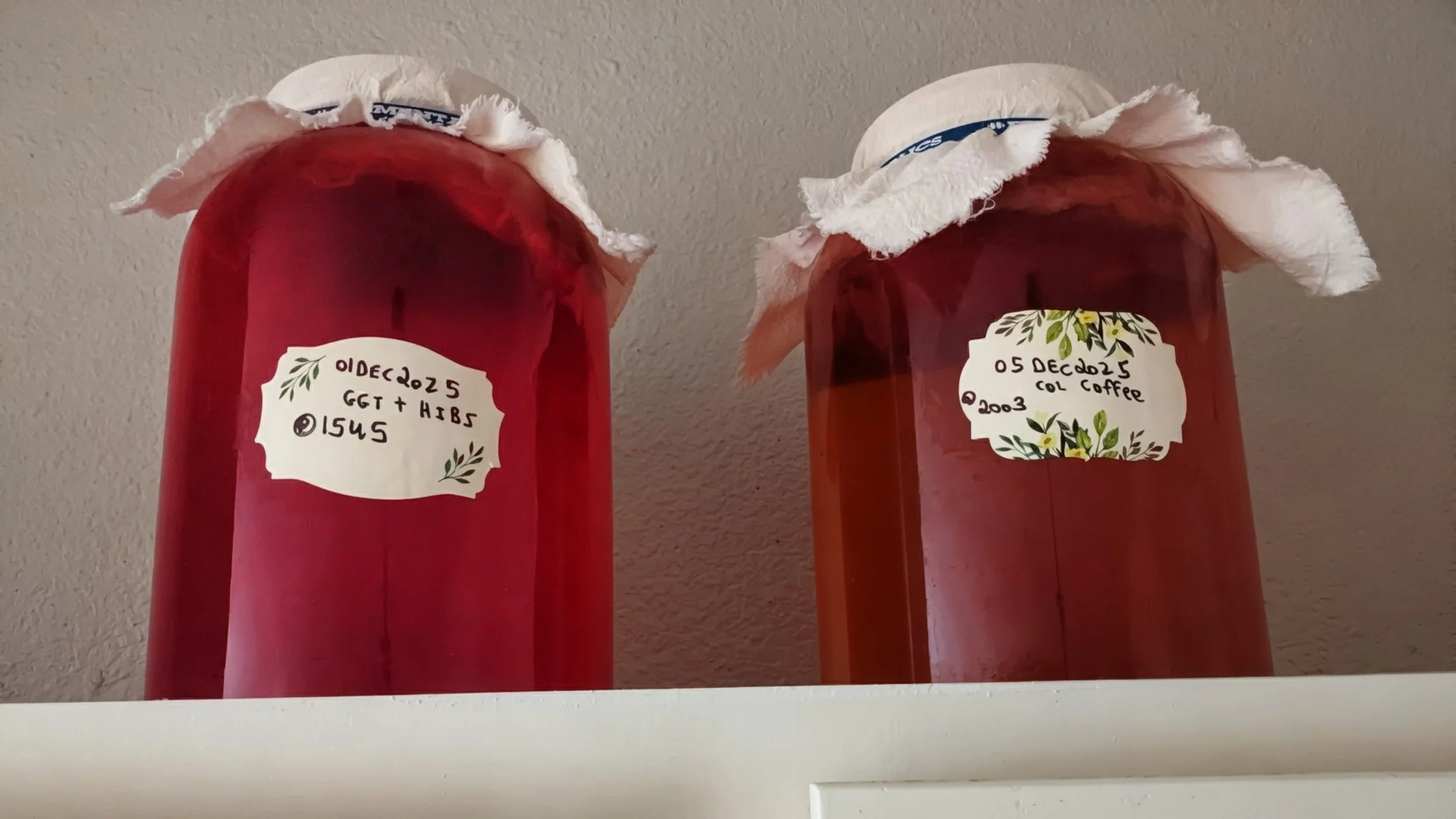
On the left, Gunpowder Green tea and Hibiscus. On the right Coffee Kombucha
You can choose different teas to make your kombucha, although herbal teas by themselves are not recommended as they don't contain all the nutrients necessary for the SCOBY. Green tea, Oolong tea, or Black tea provide many of the necessary nutrients for the yeast and bacteria to grow. I do my best to add flavor during the first fermentation as I mainly drink kombucha for its health benefits. Plus the flavors are much lighter during the first fermentation and it showcases your true ability to make a good kombucha. I generally use Gunpowder Green tea, plain Green tea or Jasmine Green tea and Chamomile tea, about equal parts Green tea to Chamomile. Other times I will use Green tea and Hibiscus flowers. By adding a mix of Green or Black tea and a herbal tea, this allows you to create your desired flavor profile while providing the nutrients necessary for fermentation.
After understanding the critical role temperature plays in fermentation, I usually try to ferment at a higher temperature around 78 F (25.6 C), but there's no way I'm turning the heat to 78 F (25.6 C) in the winter. Of course you can buy a heating wrap to better control the temperature you prefer to ferment. Temperature will affect flavor, so if you are trying to recreate the flavor from a previous batch, you want to replicate the conditions as closely as possible. While temperature is a scientific measurement, you will learn very quickly that many aspects of fermentation, the art is very much intertwined with the science.
While it may seem like a lot at first, the true payoff is crafting your own unique flavor profiles. My current goal is to create a perfect lemonade kombucha in a single fermentation. In my next article, I will share the step-by-step process of making kombucha, where we'll put all of this art and science into practice!
If you have any questions about the science or the art of brewing—especially your favorite tea combinations—please feel free to comment below! I am more than happy to help.
