Welcome to the Vibrant World of DIY Pomegranate Drinks
We all know pomegranates are nutritional powerhouses, packed with antioxidants and vitamin C. Their ruby-red arils burst with a unique, tart flavor that brightens up any morning.
However, many of us avoid them for two reasons: the notorious mess involved in de-seeding them, and the high price tag of store-bought pomegranate juice. Furthermore, if you try to juice them at home incorrectly, you often end up with a bitter, chalky drink from crushing the hard inner seeds.
Today, we are solving these problems.
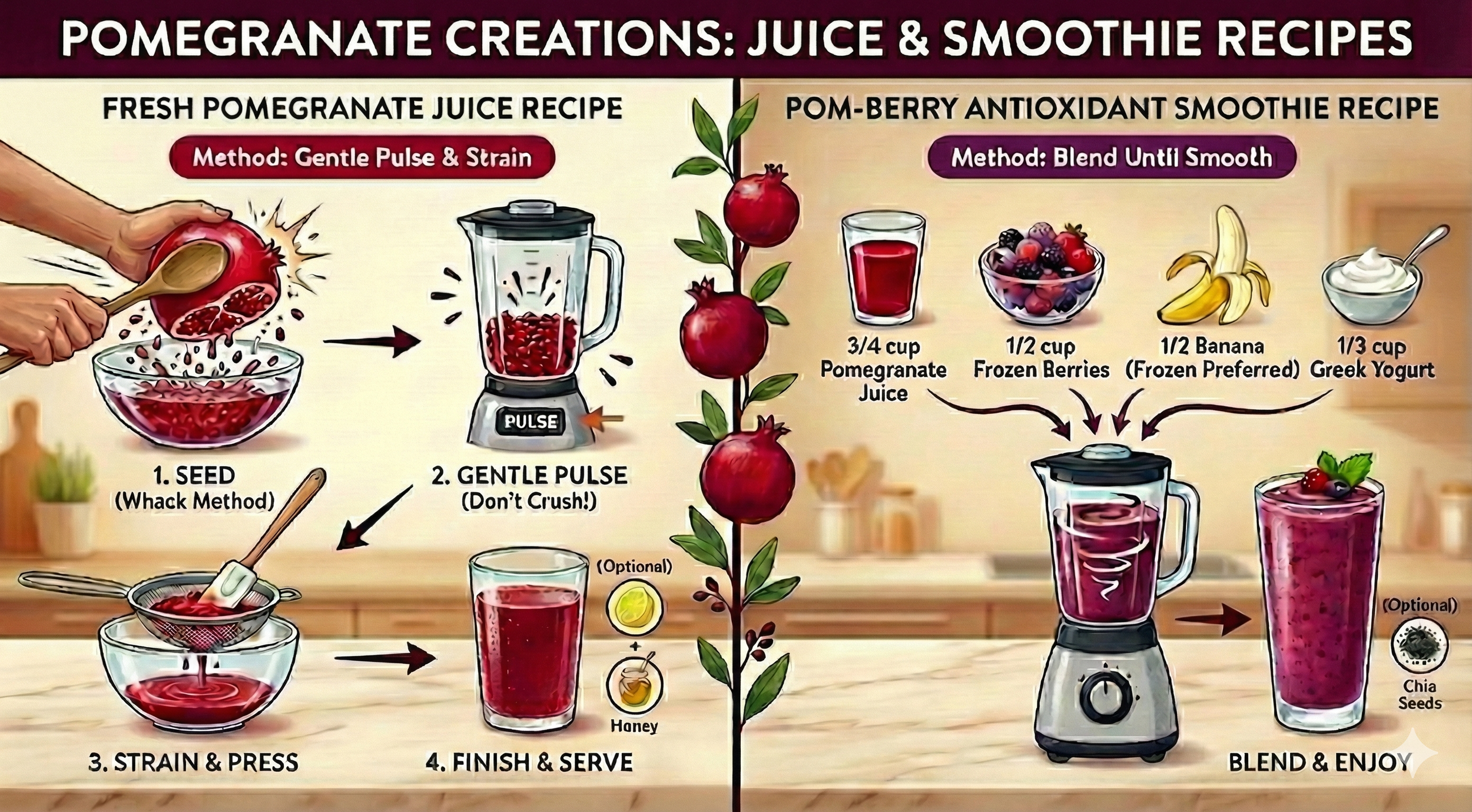
Below, we are sharing two essential recipes that will help you master this incredible fruit. There are two additional recipes for those who want to get as much out of the pomegranate as possible. First, you'll learn the secret "gentle pulse" method for extracting pure, sweet, fresh pomegranate juice without the bitterness. Second, we’ll put that fresh juice to good use in a creamy, antioxidant-rich "Pom-Berry" smoothie perfect for breakfast or a snack.
Follow the visual guide above and the detailed steps below to start enjoying the freshest pomegranate creations right at home.
Important Note Before Starting: The Stain Warning
Pomegranate juice stains everything—clothes, wood cutting boards, and porous countertops—almost instantly. Wear an apron and wipe up spills immediately.
Recipe 1: Fresh Homemade Pomegranate Juice
The goal when making pomegranate juice is to burst the red outer sacks (arils) to release the juice without crushing the hard white inner seeds, which can make the juice bitter.
This "blender pulse" method is the most efficient way to do it at home.
Prep time: 15 minutes (mostly for seeding)
Yields: roughly 1 to 1.5 cups of juice
Ingredients
2 Large Pomegranates (Choose fruits that feel heavy for their size and have taut, shiny skin)
Optional: 1 tsp Lemon juice (to brighten the flavor)
Optional: 1 tsp Honey or maple syrup (if the pomegranates are particularly tart)
Equipment Needed
A blender or food processor
A fine-mesh sieve (strainer)
A bowl
A spatula or back of a spoon
Instructions
1. Seed the Pomegranates Get the red arils (seeds) out of the pomegranate skin and membranes.
Quick Tip: Score the skin around the middle, pull the halves apart, and hold one half cut-side down over a bowl of water. Whack the back of the pomegranate firmly with a wooden spoon. The seeds will fall into the water and sink, while the white pith floats. Skim off the pith and drain the seeds.
2. The Gentle Pulse (Crucial Step!) Place the clean pomegranate arils into your blender. Do not turn the blender on high.
Pulse the blender briefly about 5 to 8 times. You only want to break open the juicy red exterior of the arils. If you blend continuously, you will pulverize the hard inner seeds, turning your juice bitter and chalky. The mixture should look slushy, but you should still see whole inner white seeds.
3. Strain the Juice Place your fine-mesh sieve over a bowl. Pour the blender mixture into the sieve.
Using a rubber spatula or the back of a sturdy spoon, press the pulp firmly against the sieve to extract as much liquid as possible. The remaining pulp in the sieve should mostly be the hard white seeds. Discard the seeds.
4. Finish and Serve Stir in the optional lemon juice or sweetener if desired. Serve immediately over ice, or store in an airtight jar in the refrigerator for up to 3 days.
Recipe 2: The "Pom-Berry" Antioxidant Smoothie
Because pomegranate seeds are hard, it is difficult to get a truly smooth texture using whole arils unless you have a very high-end, high-powered blender (like a Vitamix).
Therefore, the best pomegranate smoothies are made using the juice you just extracted above. This recipe combines that tart juice with creamy elements for a balanced breakfast or snack.
Prep time: 5 minutes
Yields: 1 large or 2 small servings
Ingredients
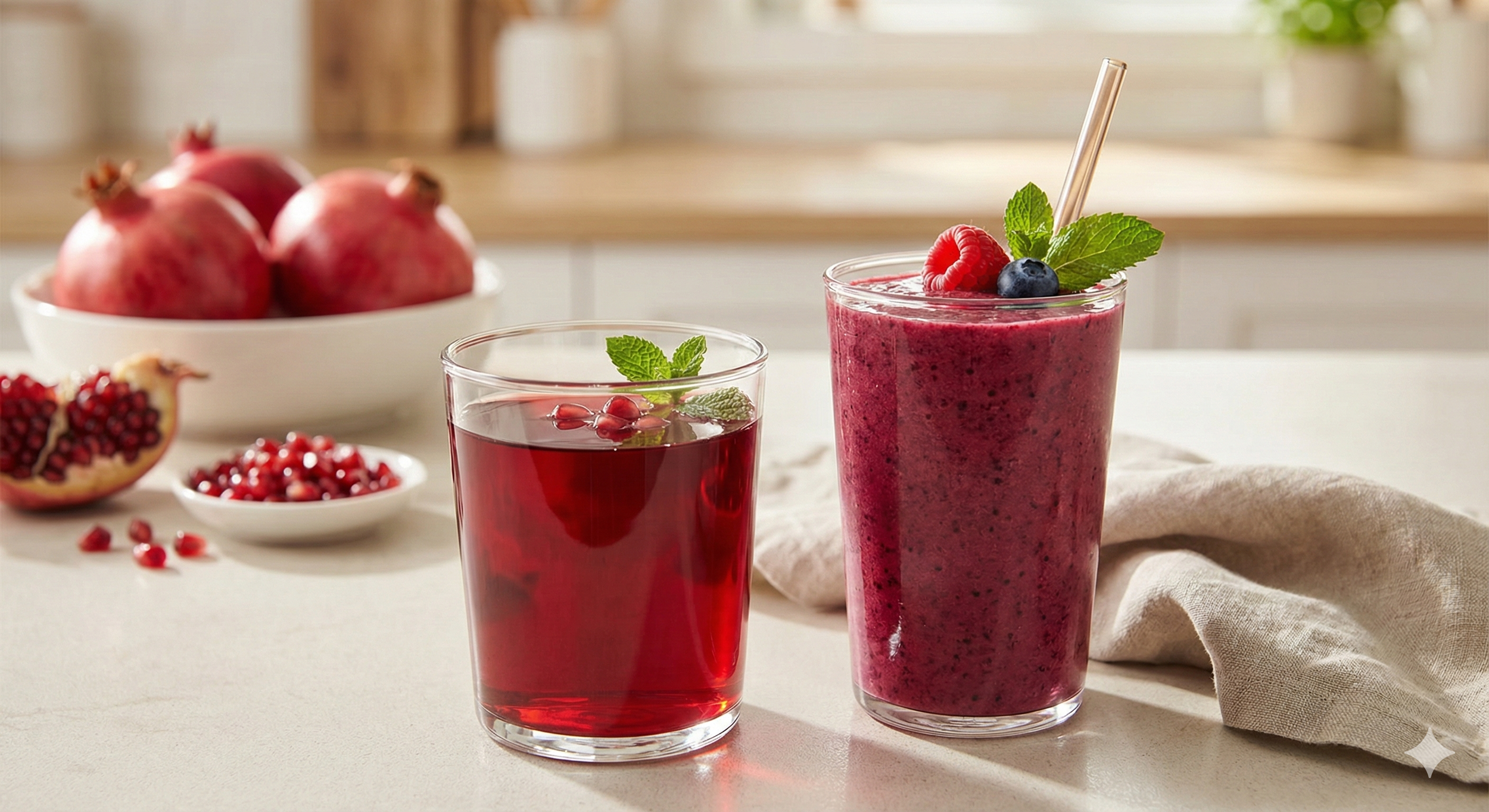
3/4 cup Pomegranate Juice (Use the fresh juice from Recipe 1, or store-bought 100% juice)
1/2 cup Frozen Mixed Berries (Strawberries, blueberries, and raspberries work best)
1/2 medium Banana (Frozen is preferred to make it creamier)
1/3 cup plain Greek Yogurt (For protein and creaminess; use coconut yogurt for a vegan option)
1 tsp Honey or Maple Syrup (Optional, depending on the sweetness of your fruit)
Optional Add-in: 1 tablespoon chia seeds or flax seeds for extra fiber.
Instructions
1. Combine Ingredients Add the pomegranate juice to the blender first (liquids first helps the blender run smoothly). Follow with the banana, frozen berries, yogurt, and sweetener/seeds if using.
2. Blend Start the blender on low speed and gradually increase to high. Blend for about 45–60 seconds until the mixture is completely smooth and uniform in color.
3. Check Consistency If the smoothie is too thick, add a splash more pomegranate juice or water. If it is too thin, add a few ice cubes and blend again.
4. Serve Pour into a glass and enjoy immediately.
If you are looking for for something a little more "hardcore," we are moving away from convenience and prioritizing potency, yield, and purity.
Standard blender recipes introduce oxygen and heat, which can degrade sensitive enzymes. The "Hardcore" approach uses cold-mechanical pressure (similar to how street vendors in Turkey or Thailand operate) or full-spectrum extraction including the bitter membranes for maximum antioxidant load.
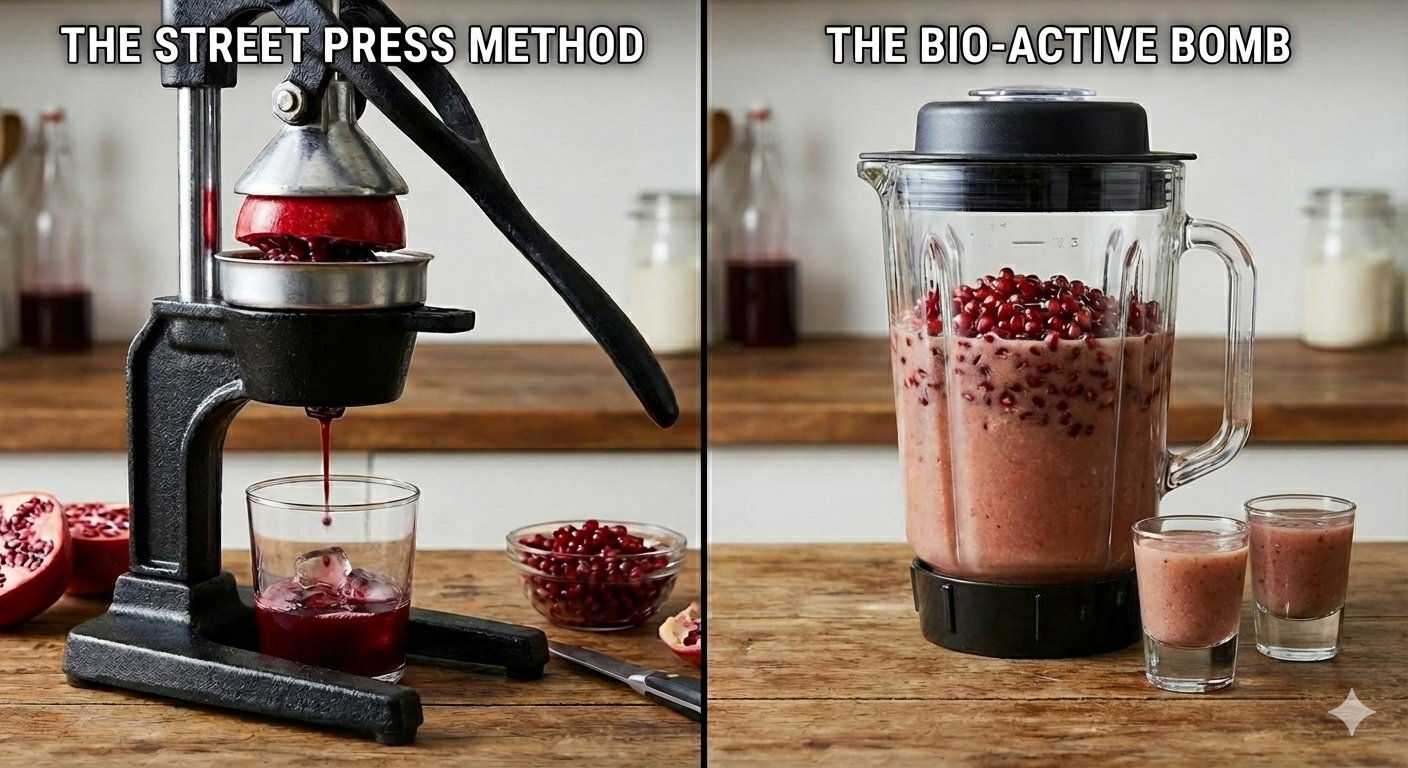
Here are two ways to do it: The "Street Press" (Culinary Purity) and The "Bio-Active Bomb" (Maximum Potency).
Option 1: The "Street Press" Method (The Purist)
Best for: Zero oxidation, superior flavor, no bitterness.
This method requires mechanical force. It extracts the juice from the arils without crushing the bitter white inner seeds, and it expresses zest oils from the skin into the juice for a complex, floral nose.
Equipment:
A heavy-duty, cast-iron lever citrus press (The kind used for grapefruits).
Alternative if you lack the press: A nut milk bag (or clean cheesecloth) and brute strength.
The Recipe:
The Cut: Slice your pomegranates horizontally (equatorially). Do not score and peel. Just chop them in half like a giant lemon.
The Press: Place the pomegranate half, cut-side down, into the press.
The Force: Crank the lever down. You need to apply serious pressure. You will hear the skins crunch and the arils pop.
The Result: The juice will run out dark, opaque, and intense. It will have zero froth (unlike the blender version).
Drink Immediately: Do not store. This is live, unoxidized juice.
(If using the nut-milk bag method: Seed the pomegranate fully, dump arils into the bag, twist the bag closed, and squeeze/knead with maximum force until only dry white seeds remain inside.)
Option 2: The "Bio-Active Bomb" (The Health Maximizer)
Best for: NRF2 pathway activation, maximum ellagic acid, and "medicinal" intake.
Most of the unique antioxidants in pomegranates (punicalagins) are actually found in the yellow/white interior membranes (pith), not just the red juice. This recipe includes them. It will be astringent and mouth-drying (tannic), like a very strong red wine.
Ingredients:
3 Large Pomegranates
1/2 Lemon (peeled) optional
1 inch fresh Ginger (unpeeled if organic) optional
Optional: Pinch of Cayenne pepper (to increase absorption/circulation)
Instructions:
Rough Shuck: Break the pomegranate open. Remove the outer leathery red skin, but leave the white/yellow membranes attached to the seeds. Do not separate them perfectly. You want that white pith.
Blend High: Place the seeds and membranes into a high-powered blender ( Add lemon, ginger, and cayenne pepper if you desire).
Liquefy: Blend on the highest setting for 60 seconds.
Heavy Strain: Pour through a nut milk bag or very fine sieve. You will need to squeeze hard to get the liquid out, as the pectin in the pith thickens it.
The Shot: Pour into shot glasses. This is not for sipping; it’s a high-potency functional tonic.
Note: Personally, I rarely drink pomegranate juice straight up, especially if you are using the whole fruit. It will be astringent. I use the juice for making Pomegranate Hibiscus Green Tea kombucha and use the pulp that was strained out for use in a smoothie. I haven’t experienced an astringent taste. if you add fruits, its going to cut through any astringent taste. If you do, adding maple syrup or more fruit will help cut through the astringency.
Conclusion: Unlocking the Ruby Fruit
The difference between a good pomegranate drink and a great one isn't just the fruit itself—it is the technique. By trading the convenience of pasteurized, store-bought bottles for the precision of the "gentle pulse" or the "fresh press," you preserve the volatile oils and delicate enzymes that define this superfood.
Whether you are blending for a creamy, protein-packed breakfast or pressing for a potent, high-tannin recovery shot, you now possess the tools to turn this notoriously difficult fruit into a daily staple. The red-stained fingers are a small price to pay for a glass that is alive, unoxidized, and unparalleled in flavor. So grab that wooden spoon, embrace the process, and drink to your health.
Note: I have yet to stain anything with pomegranate juice. It will wash out and hasn’t stained my cutting boards, but you definitely don’t want to the juice on any surfaces or clothing for long periods of time as it may stain after being absorbed by the material.
